Product Overview
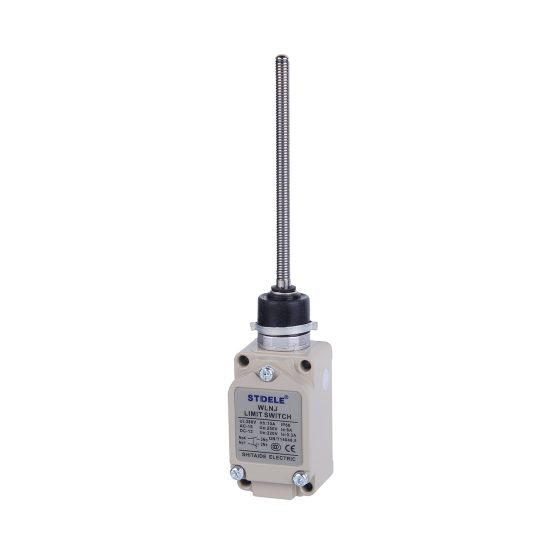
The WLNJ is a WL series heavy duty limit switch equipped with a spring rod lever actuator. It is used for mechanical position detection, travel limit control, and machine operation feedback in industrial automation equipment. The flexible spring rod actuator is suitable for applications where the moving part may contact the switch from different directions or where a wider contact range is required.
This page describes model WLNJ only. It is suitable for automation equipment, conveyors, hoist systems, cranes, elevators, machine tools, material handling equipment, and mechanical interlock systems that require a flexible actuator type limit switch.
Product Display
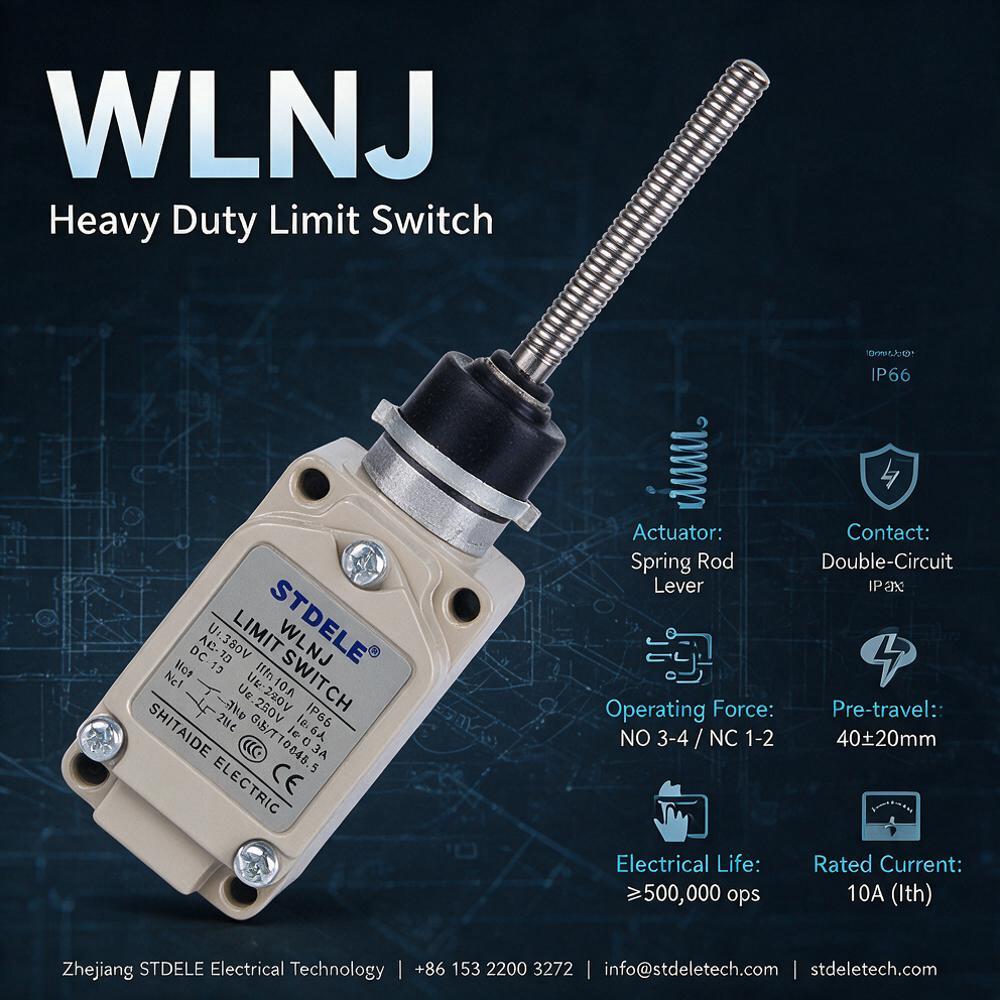
The WLNJ uses a WL series heavy duty switch body with a spring rod lever actuator. The product structure includes an aluminum alloy shell, flexible spring actuator, contact block, terminal section, and conduit connector for field wiring.
Key Technical Data
| Item | WLNJ |
|---|---|
| Product type | Heavy duty limit switch |
| Actuator type | Spring rod lever |
| Contact form | Double-circuit limit switch |
| NO terminal | 3–4 |
| NC terminal | 1–2 |
| Protection degree | IP66 |
| Operating force | 1.47N max. |
| Release force | Not specified |
| Pre-travel | 40±20mm max. |
| Overtravel | Not specified |
| Movement differential | Not specified |
| Electrical life | 500,000 operations or above |
Features
- Spring rod lever actuator for flexible mechanical position detection.
- Suitable for applications where the operating part may contact the actuator from different directions.
- Double-circuit limit switch structure for NO and NC control logic.
- Aluminum alloy shell construction for mechanical strength.
- Water-proof and oil-proof structure for demanding industrial environments.
- Built-in contact box with double-spring mechanism for long mechanical life.
- IP66 protection degree when properly installed and sealed.
- Suitable for equipment travel control, position detection, and mechanical interlock applications.
- WL series provides multiple actuator configurations; this page focuses on WLNJ only.
Drawing
Outline and Mounting Dimensions
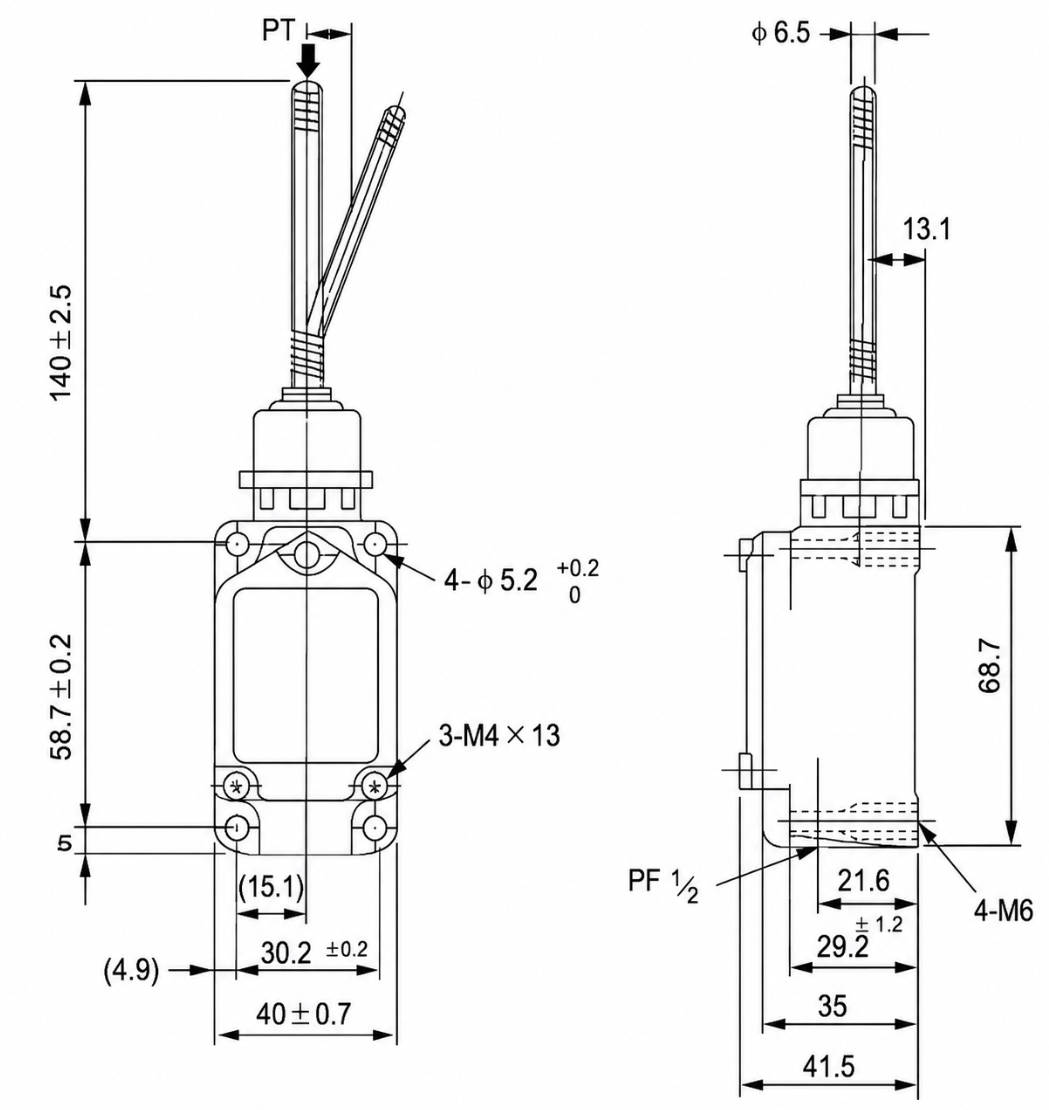
The drawing is used to confirm the WLNJ switch body size, mounting hole position, spring rod actuator direction, operating range, and conduit entry location. Before installation, check that the moving mechanical part can contact the spring rod smoothly without excessive impact or permanent deformation.
Contact Form

The WLNJ uses a double-circuit limit switch contact structure. The normally open contact uses terminals 3–4, and the normally closed contact uses terminals 1–2. The contacts change state when the spring rod actuator is operated by the moving mechanical part.
Select the wiring logic according to the control circuit. For safety-related or fault-detection circuits, NC logic is often preferred, but the final wiring method should follow the machine electrical design.
Ratings
Rated Load
| Rated Voltage | Resistance Load NC | Resistance Load NO | Lamp Load NC | Lamp Load NO | Inductive Load NC | Inductive Load NO | Motor Load NC | Motor Load NO |
|---|---|---|---|---|---|---|---|---|
| 125VAC | 10A | – | 3A | 1.5A | 10A | – | 5A | 2A |
| 250VAC | 5A | – | 2A | 1A | 5A | – | 3A | 1A |
| 480VAC | 3A | – | 1.5A | 0.8A | 3A | – | 1.5A | 0.8A |
| 600VAC | 1A | – | 1A | 0.5A | 1.5A | – | 1A | 0.5A |
| 8VDC | 10A | – | 6A | 3A | 10A | – | 6A | – |
| 14VDC | 10A | – | 6A | 3A | 10A | – | 6A | – |
| 30VDC | 6A | – | 4A | 3A | 6A | – | 4A | – |
| 125VDC | 0.8A | – | 0.2A | 0.2A | 0.8A | – | 0.2A | – |
| 250VDC | 0.4A | – | 0.1A | 0.1A | 0.4A | – | 0.1A | – |
Load Notes
- Surge current: NC 30A under, NO 20A under.
- Inductive load has a power factor of 0.4 minimum for AC and a time constant of 7 ms maximum for DC.
- Lamp load inrush current is approximately 10 times the steady-state current.
- Motor load inrush current is approximately 6 times the steady-state current.
- For inductive, lamp, or motor loads, consider inrush current during circuit design.
Specifications
Electrical
| Item | Specification |
|---|---|
| Contact resistance | 25 mΩ max., initial value |
| Insulation resistance | 100 MΩ min. at 500 VDC |
| Dielectric strength 1 | 1500 VAC, 50/60 Hz for 1 minute between current-carrying and non-current-carrying metal parts |
| Dielectric strength 2 | 1500 VAC, 50/60 Hz for 1 minute between each terminal and ground |
| Electrical life | 500,000 operations or above |
Mechanical
| Item | Specification |
|---|---|
| Operating speed | 1 mm to 1 m/s |
| Operating frequency | Electrical: 30 operations/min |
| Vibration | 10–55 Hz, 1.5 mm double amplitude |
| Shock durability | 1000 m/s², approx. 100G |
| Shock malfunction | 300 m/s², approx. 30G |
Environmental
| Item | Specification |
|---|---|
| Ambient temperature | -20°C to +80°C, with no icing |
| Humidity | <95% RH |
| Protection degree | IP66 |
Operating Characteristics
The following operating characteristics apply to model WLNJ only. The actuator movement range and contact direction should be checked according to the machine structure and the movement of the operating part.
| Parameter | Description | WLNJ |
|---|---|---|
| OF | Operating force, maximum | 1.47N |
| RF | Release force, minimum | Not specified |
| PT | Pre-travel, maximum | 40±20mm |
| OT | Overtravel, minimum | Not specified |
| MD | Movement differential, maximum | Not specified |
Selection Guide
Actuator and Contact Direction
WLNJ uses a spring rod lever actuator. It is suitable when the moving part may contact the actuator from different directions or when a longer and more flexible sensing area is required. The actuator should be contacted smoothly and should not be bent beyond its allowable operating range.
Electrical Load and Contact Rating
Confirm the circuit voltage, current, load type, and contact logic before selection. For motor, lamp, or inductive loads, select the switch according to inrush current as well as steady-state current.
Stroke and Reset
For WLNJ, the operating force is 1.47N maximum and the pre-travel is 40±20mm maximum. The operating part should actuate the spring rod reliably and allow the actuator to return to its neutral position after operation.
Installation Environment
WLNJ has IP66 protection and is suitable for dusty, oily, and general industrial environments when properly installed. The cable entry and conduit connector should be sealed correctly. Avoid continuous immersion and excessive direct impact.
Replacement Check
Before replacing an existing limit switch with WLNJ, check actuator type, mounting dimensions, spring rod length, operating direction, rated load, conduit size, wiring logic, and available space around the actuator.